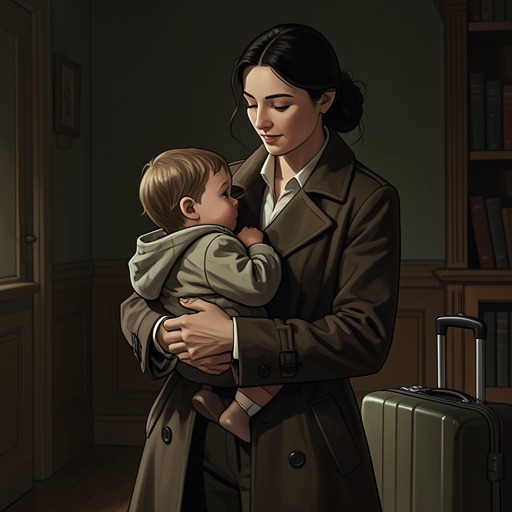
The Narrator and Her Mother
The Character of RainThe Narrator (God) and Mother are bound by care, but they repeatedly understand the same childhood moment in different ways. Mother feeds, comforts, and protects a child whose silence and unusual sense of agency she cannot fully interpret; the Narrator, meanwhile, experiences adult expectations as limits and later experiences the possibility of separation from Japan as a collapse of the world. Their relationship moves between practical tenderness and interpretive distance, becoming especially vivid when Mother has to respond to the child’s fear and physical danger.
Early Care and the Diagnosis of Inertness
When the newborn does not move toward Mother’s breast, Mother first tries to breastfeed, placing the baby nose to nose with her and then forcing the nipple into the child’s mouth. The baby barely sucks, so Mother switches to a bottle. The cylindrical bottle suits the infant’s apparent preferences, and Mother feeds the child several times a day. The account makes the practical care unmistakable while adding an irony the parents do not perceive: bottle-feeding reinforces the child’s attachment to tube-like forms.
The specialists’ examination gives the family a name for the baby’s unusual condition, calling it pathological apathy. They recommend hospital care, but the parents disregard that advice. They already have two children described as full-fledged members of the human race, and accept the idea of a third who is a vegetable; the diagnosis even prompts tender feelings. Mother and Father sweetly call the child the Plant. This response is affectionate, but it also places the infant inside an adult category that mistakes stillness for a plantlike state rather than recognizing the child’s own account of an inward life.
The developmental silence continues. By the age of two, the child has not tried to crawl or made a peep, and the adults—including the parents, doctors, and nanny—assume there must be a developmental blockage. Mother later interprets the child’s anger as evidence that the child knows she is late to develop. That interpretation is explicitly wrong: the Narrator does not believe herself behind, because that would mean accepting comparison with others. Her frustration instead comes from feeling powerful while being unable to make her mouth perform as she wishes. The difference between Mother’s explanation and the Narrator’s account establishes a recurring pattern: Mother responds to visible behavior, while the child’s motives remain concealed within an active inner world.
Speech, Recognition, and Misreading
When the Narrator begins to walk and speak, the difference between outward performance and inward experience becomes central to the bond. She considers which word to say first and chooses a familiar family word because parents need such assurances and because she wants to keep her private knowledge secret. Her first spoken word is Mama. Mother and Father scoop her up and kiss her, delighted; the Narrator judges that their happiness depends on being confirmed in their parental roles. To Mother, the utterance appears to mark the child’s entry into speech. To the child, it is a deliberate choice made after a long, unspoken period of thought.
The Narrator distinguishes sharply between having words in her head and saying them aloud. Public speech gives a word weight and recognition, but it also reveals something about the speaker. She therefore delays choosing another word, even as Mother and Father take the pause as proof that they are the child’s greatest necessity. Their response is loving, yet it rests on a mistaken reading of what the silence means. Mother’s earlier belief that the child is angry about developmental delay belongs to the same divide: she interprets the child through ordinary developmental expectations, while the Narrator experiences her own speech as a matter of choice, secrecy, and control.
Attachment and the Threat of Departure
The Narrator’s bond with Mother is tested when she overhears that Nishio-san may leave. She runs to her parents and communicates what she has heard; Father is furious with Kashima-san and speaks privately with Nishio-san, while the Narrator stays in Mother’s arms, sobbing and repeating that Nishio-san has to remain with her. Mother gently explains that the child will leave Nishio-san someday regardless, because Father will not stay in Japan forever and the family will eventually go. She suggests that the present may be a good time for the separation, but the child cannot absorb this as a practical explanation. It arrives alongside the possible loss of Nishio-san and the home around which the child has organized her sense of belonging.
When the Narrator protests that she cannot leave, Mother asks whether she no longer wants to live with her parents. The child says that she does, but insists that they must stay in Japan too. Mother first laughs at the child’s hope that she was only teasing, then clarifies that she was not: one day the family will leave Japan. The Narrator responds that Japan is her country and the house is her home; Mother answers that it is not the child’s country. The exchange exposes a profound difference in scale. Mother is explaining a future family move, while the Narrator hears the withdrawal of an entire world. Her efforts to prepare the child do not make the prospect comprehensible or less frightening.
Protection in Crisis
The contrast between distance and care sharpens in the Narrator’s near-drowning. As the child struggles in the water, people watch without intervening, following what the Narrator identifies as a Japanese principle against saving another person because rescue creates a crushing debt of gratitude. The child calls for help first in Japanese and then in French. The episode ultimately forces a public disclosure: after rescue, the Narrator tells Hugo that she has been talking for a long time. Mother is not the focus of the rescue itself, but this earlier crisis helps define the risks surrounding the child’s speech and the limits of the adult world’s understanding.
Later, when Nishio-san finds the Narrator in the koi pond and revives her, Mother takes one look at the child and screams. Nishio-san runs into the house carrying her, and Mother immediately calls for a journey to Kobe Hospital. Nishio-san accompanies them to the car, explaining how she found the child in a mixture of Japanese, French, English, and groans. Mother’s reaction is immediate and physical: the child’s danger is no longer an argument about development or belonging but a visible emergency demanding action.
Afterward, the Narrator says she does not want to feed the carp again. Mother understands this as fear of falling into the water and promises that the child will never have to feed them again. The Narrator recognizes that at least her action has not been in vain; Mother then offers a compromise, saying she will hold the child in her arms and they will feed the carp together. The promise does not undo what happened, but it changes the activity from a danger the child must face alone into something Mother will share.
The Relationship’s Pattern
Across these episodes, Mother’s care is concrete: she attempts to breastfeed, changes to a bottle when that fails, holds the child through sobs, arranges urgent transport after the pond incident, and offers to accompany her at the carp pond. The strain in the relationship does not arise from an absence of care. It arises because Mother repeatedly explains the child through expectations the Narrator does not share—normal development, parental roles, and the eventual family departure from Japan. The Narrator’s inward speech and intense attachment make those explanations inadequate to the child’s experience, even when they are intended to reassure.
The relationship thus joins tenderness to a persistent asymmetry of knowledge. Mother can recognize distress and answer it with touch, protection, or promises, but she cannot always know what the child has already thought or what a future separation signifies to her. The Narrator, for her part, depends on Mother’s care even while keeping much of her mental life hidden. Their encounters move from the misread silence of infancy to more direct pleas and negotiations, without dissolving that gap. What changes is not that Mother suddenly understands everything, but that moments of danger and fear make their dependence on one another unmistakable.